Securities Fraud Lawyer Costs and Fees: What Investors Should Expect to Pay
You lost money in an investment, and now you are weighing whether a lawyer costs more than the claim is worth. The fee model a securities attorney uses decides that math before a single document gets filed.
This article breaks down contingency fees, hourly rates, and hybrid arrangements, then covers what investors actually pay at Haselkorn & Thibaut, P.A., operating as InvestmentFraudLawyers.com. You will also see how FINRA arbitration versus court changes your total cost, and which expenses fall outside attorney fees.
What Is Haselkorn & Thibaut, P.A., operating as InvestmentFraudLawyers.com?
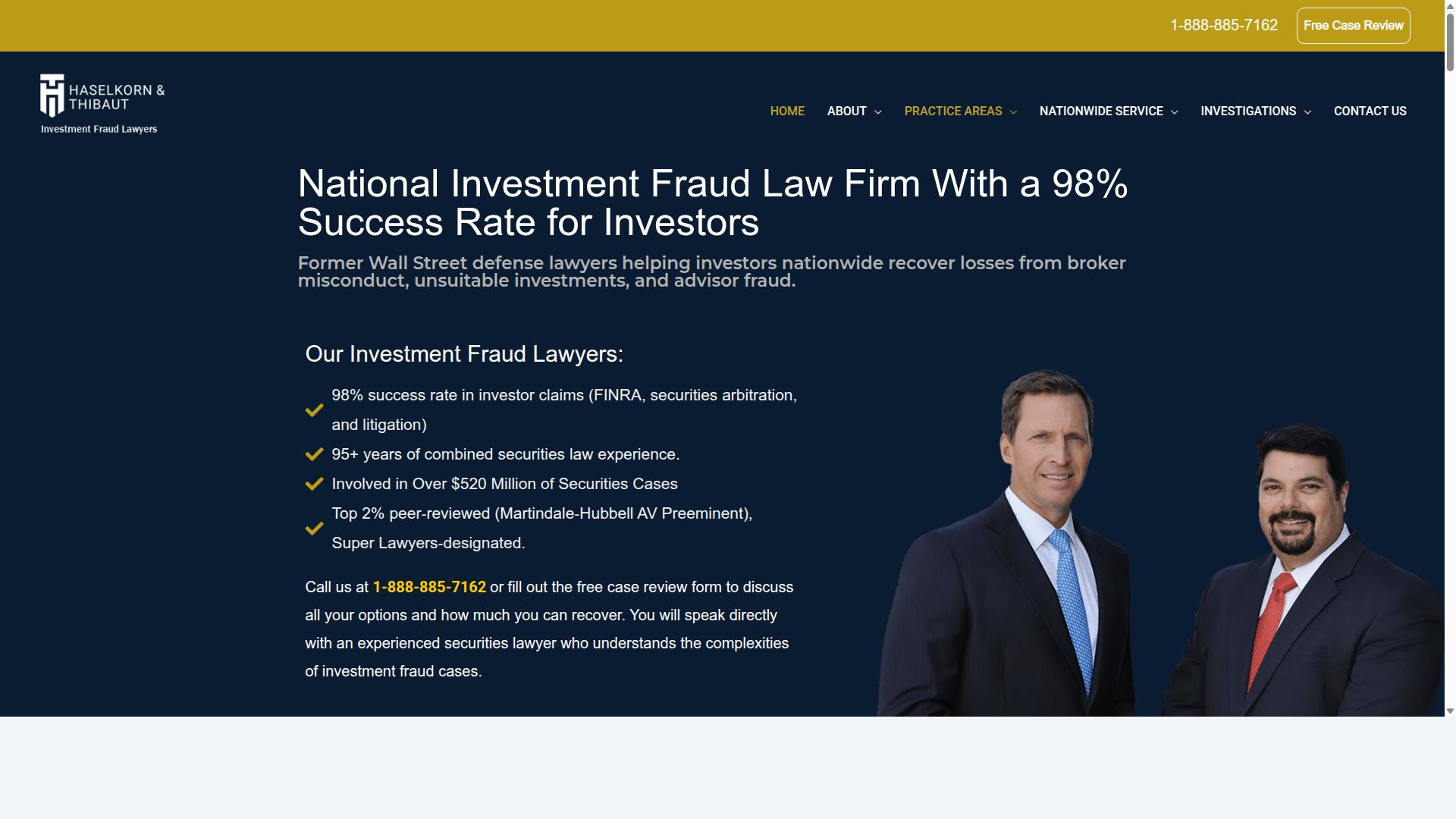
Haselkorn & Thibaut, P.A., operating as InvestmentFraudLawyers.com, is a national securities and investment fraud law firm that represents individual investors in disputes against brokerage firms and financial advisors. The practice is deliberately narrow: it handles investor-side claims only, which keeps its focus on the people who lost money rather than the firms that took it.
The firm was founded by two former Wall Street defense lawyers. Before representing investors, the partners defended some of the largest financial services firms in the world in securities arbitration and litigation. That background gives them an insider view of how brokerage firms build their cases, where they cut corners, and where their arguments are vulnerable.
Its main office is in Juno Beach, Florida, with a New York office as well. The firm pursues recovery through FINRA arbitration, AAA arbitration, JAMS arbitration, and state and federal court litigation, and it describes its model as "Big-Firm Results. Boutique-Firm Service." Clients work directly with the two partners, not a rotating team of associates, from the first consultation through resolution.
That structure matters when you are weighing legal fees. A boutique practice with two partners handling the matter personally tends to give investors a clearer picture of who is doing the work and what a case will cost to pursue. The firm offers a free, confidential case evaluation and works on a "No recovery, no fee" basis in investor cases, which shapes the cost conversation that follows in this article.
Who the Firm Serves and the Misconduct It Handles
The firm serves individual investors, retirees, families, trusts, and estates across the United States who have suffered losses due to broker misconduct, unsuitable investment recommendations, advisor fraud, or fraudulent schemes. It has also represented corporations, pension plans, and charitable organizations. Older investors and the families of elder financial abuse victims are a particular focus.
The misconduct it handles falls under a few broad categories:
- Investment fraud and securities fraud, including fraudulent schemes that stripped value from an account
- Financial advisor fraud, where a trusted professional misled a client or misused their money
- Broker misconduct, such as unsuitable investment recommendations
The firm operates nationwide and represents investors in all 50 states. Its FINRA arbitration practice allows clients to meet in person or remotely, so geography does not decide whether a claim can move forward. That reach is useful for investors who live far from a major financial center but still need a securities attorney licensed to pursue a claim against a brokerage firm.
One distinction is worth stating plainly: the firm does not represent brokerage firms or financial advisors. It represents investors only. For a plaintiff weighing a claim, that single-minded alignment removes the conflict that can arise when a lawyer has ties to the other side of the table. It also means the fee structure is built around investor claims, which is the subject of the sections that follow.
How Securities Fraud Lawyers Charge: The Main Fee Models Explained
Securities fraud lawyers typically use one of three fee models: contingency fees, hourly rates, or hybrid arrangements that combine both. Which model applies to your matter depends on the type of case, your preferences as a client, and how the law firm structures its practice.
Most investor-side securities attorneys work on contingency, meaning they are paid only if the claim produces a recovery. That structure aligns the lawyer's interests with the client's outcome and limits upfront cost for the investor. Hourly billing appears more often on the defense side or in unusual matters where the scope of work is hard to predict.
Some firms blend the two approaches. A reduced hourly rate may be paired with a smaller contingency percentage, or a firm may charge hourly through the early stages and shift to contingency if the case proceeds to securities arbitration or court litigation.
Before signing anything, read the fee agreement and engagement letter carefully. These documents should spell out how the lawyer is paid, who covers out-of-pocket costs, and what happens if the case is lost or withdrawn.
Contingency Fees, Hourly Rates, and Hybrid Arrangements
A contingency fee means the lawyer receives a percentage of the recovery only if the client wins, while an hourly rate charges for time spent regardless of outcome. Each model shifts risk in a different direction, and understanding that tradeoff helps investors choose wisely.
Contingency fees are the standard in plaintiff-side securities arbitration and individual claims against brokerage firms or financial advisors. The client pays nothing upfront, and the attorney's percentage comes out of the settlement or award. This is common in FINRA arbitration, where investors pursue claims for unsuitable recommendations, churning, or misrepresentation.
Hourly rates for experienced securities attorneys commonly fall in the $300 to $1,000+ per hour range, depending on experience and market. Defense work, complex commercial litigation, and matters with unpredictable scope tend to be billed this way. Hourly cases usually require a retainer, an upfront deposit the lawyer draws against as work is performed.
Hybrid arrangements combine a reduced hourly rate with a smaller contingency percentage. Firms may use this structure when a case demands significant upfront investigation, document review, or expert analysis before the likelihood of recovery is clear.
- Contingency: no upfront fee, percentage taken from recovery, common for investor claims
- Hourly: paid for time worked, retainer typically required, common for defense and complex matters
- Hybrid: lower hourly rate plus reduced contingency, used when early work is substantial
Whatever the model, ask whether out-of-pocket costs such as filing fees, expert witness fees, deposition expenses, and administrative fees are advanced by the firm or billed to you separately. That detail can matter as much as the percentage itself.
Typical Percentage Ranges and What Drives Them
Contingency fees in securities fraud cases generally range from 33% to 40% of the recovery, with the exact percentage influenced by factors such as case complexity, the stage of resolution, and whether the case goes to arbitration or court.
Several variables move that number up or down. A straightforward claim that settles early may land at the lower end, while a matter that proceeds through a full FINRA arbitration hearing or court litigation may justify a higher percentage because of the time and expense involved.
The size of the claimed damages also plays a role. Larger recoveries sometimes carry a slightly lower percentage because the total fee remains substantial, while smaller claims may carry a higher percentage to make the representation economically viable.
Some firms use a sliding scale. The percentage may increase if a case proceeds to appeal after an award or judgment, reflecting the additional work required at that stage. Others reduce the percentage if the matter resolves quickly through mediation or early settlement talks.
Here is a simple illustration. On a $100,000 recovery at a 35% contingency fee, the attorney receives $35,000 and the client receives $65,000 before any separately billed costs. On a $500,000 recovery at the same rate, the fee is $175,000 and the client keeps $325,000. If costs are deducted from the recovery before the percentage is applied, the client's net changes accordingly, which is why the order of calculation matters.
Ask any securities attorney to walk through a hypothetical recovery at your expected damages level. A clear answer, in writing, is a sign of a well-drafted fee agreement and a transparent cost structure.
What Investors Actually Pay at Haselkorn & Thibaut, P.A., operating as InvestmentFraudLawyers.com
At Haselkorn & Thibaut, P.A., operating as InvestmentFraudLawyers.com, investor cases are generally handled on a contingency basis, meaning clients pay nothing unless money is recovered.
That single fact answers the most common question investors ask before hiring a securities fraud lawyer: what will this cost me out of pocket? For most investor claims, the answer is nothing to start and nothing if the case fails.
The firm's approach removes the financial barrier that keeps many harmed investors from pursuing a claim against a brokerage firm or financial advisor. Instead of billing by the hour while a case unfolds, the firm's compensation is tied to the outcome. When the lawyer only gets paid after a recovery, the client's interests and the firm's interests point in the same direction.
Fee arrangements can vary depending on the case. The firm's published FAQ notes that structures may include hourly, contingency, hybrid, or alternative arrangements, but in most investor cases there is no fee unless the firm recovers funds. The subsections below explain how that model works in practice and what the free evaluation process involves.
No Recovery, No Fee: How the Contingency Model Works
Under the no recovery, no fee model, clients pay no attorney fees unless the firm successfully recovers money on their behalf. This is a contingency fee, meaning the fee is a percentage of the recovery rather than a charge for time spent.
The mechanics are straightforward. The firm advances the costs of pursuing the claim, and the agreed percentage is deducted only from money actually recovered. If the case produces no recovery, the client owes nothing.
Before work begins, the client and the firm sign a fee agreement and engagement letter. That document spells out the percentage, what costs are covered, and how a recovery would be distributed. The percentage is agreed upon upfront and may vary based on the specifics of the case, such as its size, complexity, and the venue where it is heard.
This structure is standard for investor-side securities arbitration. Claims against brokerage firms are typically brought through FINRA arbitration rather than court litigation, and contingency fees are the norm in that forum. A class action follows a similar logic, while an individual claim gives the investor more control over strategy and settlement decisions.
For investors weighing whether to act, the model changes the risk calculation. There is no retainer to fund, no hourly rate ticking upward during discovery, and no exposure to out-of-pocket costs like filing fees, expert witness fees, or deposition expenses if the claim does not succeed.
Free, Confidential Case Evaluation and No Upfront Payment
Haselkorn & Thibaut offers a free, confidential case evaluation to determine if you have a viable claim, with no upfront payment required. Potential clients can call or submit information online, and the firm reviews the matter at no cost.
No retainer is needed to get started. That means an investor can describe what happened, share account statements or correspondence, and get a professional read on whether the losses may be recoverable, all before any money changes hands.
The consultation is available by phone, in person, or virtually, and the details shared are treated as confidential. During the evaluation, the discussion generally covers:
- What the financial advisor or brokerage firm did, and when
- The type of account and investments involved
- Documents such as statements, trade confirmations, and communications
- Whether the matter fits securities arbitration, court litigation, or another path
- How a contingency fee arrangement would apply if the case moves forward
Because the firm only gets paid if it recovers money for the client, the initial consultation carries no financial risk. Investors who are unsure whether they have a claim can find out where they stand without committing to anything, which makes the first step toward a possible recovery far less daunting.
Costs Beyond Attorney Fees: Filing Fees, Expert Witnesses, and Arbitration Expenses
Along with attorney fees, investors may face costs such as FINRA filing fees, expert witness fees, and expenses for discovery, depositions, and travel. These are the "hard costs" of pursuing a securities fraud claim, and they can add up quickly. Understanding them before signing a fee agreement helps investors avoid surprises later.
The good news is that in most contingency fee arrangements, the law firm advances these costs on the client's behalf. You typically do not pay them upfront. Instead, they are repaid from any recovery at the end of the case.
If the claim fails and there is no recovery, responsibility for these costs depends on the language in your engagement letter. Some agreements state the client owes nothing; others require repayment of advanced costs. Read that clause carefully before signing.
Below is a breakdown of the most common expenses investors encounter in FINRA arbitration and securities litigation.
- FINRA filing fees: Roughly $50 to $2,250, scaled to the size of the claim.
- Expert witness fees: Often $300 to $1,000 per hour, plus report preparation.
- Discovery costs: Document production, subpoenas, and records retrieval.
- Deposition expenses: Court reporter, transcript, and sometimes videography.
- Travel expenses: Flights, lodging, and meals for hearings away from home.
- Copying and postage: Small individually, but they accumulate over a long case.
The FINRA filing fee is one of the few costs with a published schedule. It rises in tiers as the amount in controversy grows, so a modest individual claim pays far less than a multi-million dollar dispute. Smaller claims often carry the lightest filing burden.
Arbitration also involves administrative fees tied to the number of hearing sessions and the size of the arbitration panel. A single arbitrator costs less than a three-member panel, which matters when damages are large enough to justify one.
Expert witnesses are frequently the single largest cost after attorney time. A securities industry expert may charge several hundred dollars per hour to analyze account statements, trading records, and whether a financial advisor's conduct fell below industry standards. Their hourly rate reflects specialized knowledge.
Discovery costs include retrieving documents from the brokerage firm, issuing subpoenas to third parties, and reviewing thousands of pages of records. Deposition expenses cover the court reporter and transcript, which can run into the thousands for a single session.
Travel, copying, and postage look minor on their own. Across a case lasting a year or more, however, they can total several thousand dollars. Investors pursuing an individual claim should ask how these costs are tracked and reported.
Mediation adds another layer. If the parties agree to mediate before or during arbitration, there may be a mediator's fee split between sides. That cost is usually modest compared to a full hearing but still worth budgeting for.
Appeals are rare in FINRA arbitration because the grounds are narrow, but court litigation offers broader appeal rights at correspondingly higher expense. Every stage adds cost, so case strategy should match the size of the damages sought.
For class actions, costs are handled collectively and individual plaintiffs rarely pay anything out of pocket. Individual claims and securities arbitration work differently, which is why the fee agreement matters so much.
Before retaining a securities attorney, ask three questions: Who advances the costs? How are they documented? What happens if the case loses? A clear answer to each protects the investor and sets realistic expectations from day one.
Investors should also confirm whether the firm charges interest on advanced costs, whether cost reimbursement is capped, and how a partial recovery is divided. These details belong in writing, not in a verbal handshake.
In short, filing fees, expert witness fees, discovery, depositions, travel, and administrative charges are real parts of a securities fraud case. In a contingency structure, they are usually carried by the firm and repaid only from a successful recovery, which keeps the investor's upfront exposure low. Understanding the cost structure turns a confusing process into a manageable one.
FINRA Arbitration vs. Court: How the Forum Affects Your Total Cost
Choosing between FINRA arbitration and court litigation can significantly impact the total cost of pursuing a securities fraud claim. Most disputes between investors and brokerage firms are resolved through securities arbitration, but some claims belong in court. Understanding how each forum shapes your expenses helps you plan for out-of-pocket costs and negotiate a fair fee agreement.
The forum you select affects nearly every line item in your budget. Filing fees, discovery costs, expert witness fees, and even the percentage a securities attorney charges can all shift depending on whether your case goes to a FINRA arbitration panel or a courtroom judge.
Below is a general comparison of the two paths. Exact figures vary by claim size, complexity, and the rules in effect at the time you file.
| Cost Factor | FINRA Arbitration | Court Litigation |
|---|---|---|
| Filing fees | Typically lower, scaled to claim amount | Generally higher, varies by jurisdiction |
| Timeline | Usually months, not years | Often longer, sometimes multi-year |
| Appeals | Extremely limited | Full appellate process available |
| Discovery | Focused, panel-controlled | Broad, can be costly and drawn out |
| Expert witnesses | Common but streamlined | Often more extensive |
| Attorney fee structure | Contingency fee common | Contingency or hourly, varies |
FINRA arbitration is typically faster and less expensive for the individual investor. The process is designed to resolve disputes efficiently, and the limited appeals process means fewer opportunities for a brokerage firm to delay payment of an award. For most individual claims against a financial advisor or brokerage firm, arbitration is the standard route.
Court litigation may be necessary for certain claims, such as those involving parties who never signed an arbitration agreement or matters that fall outside FINRA's jurisdiction. Court also allows for a full appeal, which can matter when a legal error is at issue. That flexibility comes with a price: longer timelines, broader discovery, and higher administrative expenses.
Attorney fees can differ by forum as well. A contingency fee percentage may be structured differently in arbitration versus court because of the time and risk involved. Some firms charge a flat fee or hourly rate for specific court motions, while arbitration costs are more often folded into a single contingency arrangement. Always review the engagement letter carefully to see how fees and expenses are handled in each forum.
Practical examples help illustrate the gap. A modest claim heard by a FINRA arbitration panel might involve limited discovery, one hearing, and a resolution within a year. The same dispute in court could require multiple depositions, written motions, and a trial date years away, each step adding to out-of-pocket costs for the investor.
Before filing, ask your securities attorney which forum applies to your claim and why. A clear answer up front helps you compare cost structures, understand the fee agreement, and set realistic expectations for recovery.
Why the Partners' Defense-Side Background Can Reduce Wasted Time and Expense
The partners at Haselkorn & Thibaut are former Wall Street defense lawyers who defended some of the largest financial institutions before switching to represent individual investors. That career path is unusual in securities arbitration, and it has a direct effect on what a claim costs to pursue.
When a securities attorney has sat on the other side of the table, they already understand how a brokerage firm builds its defense. They know which arguments get raised early, which documents the firm hopes nobody requests, and where the defense tends to be weakest.
That knowledge matters because every hour spent learning an opponent's playbook is an hour billed to the client. A lawyer who already knows the playbook can move faster and spend less.
Anticipating defenses before they are filed. Defense counsel for a large firm often rely on a familiar set of arguments: that the investor was sophisticated, that losses came from market conditions rather than misconduct, or that the claim falls outside a filing window. A former defense lawyer can predict these positions and build the client's case to address them from the start.
That reduces the back-and-forth that drives up discovery costs and deposition expenses. Instead of reacting to each defense motion as it arrives, the case is structured to make those motions harder to file in the first place.
Fewer unnecessary motions means fewer billable hours, and in a contingency fee arrangement, fewer wasted hours also mean a leaner path to recovery.
- Knowing which documents a firm is most reluctant to produce, which sharpens discovery requests
- Recognizing settlement pressure points earlier, which can shorten FINRA arbitration timelines
- Avoiding procedural missteps that generate avoidable motion practice and delay
- Framing damages in terms a defense-side reviewer would find credible
Partner Jason Haselkorn served as General Counsel for a regional broker-dealer and SEC-registered investment advisory firm. That in-house perspective adds another layer: he has seen how firms evaluate claims internally, including when they decide a matter is worth settling rather than litigating.
The firm brings 95+ years of combined securities law experience and has been involved in over $520 million of securities cases. Clients work directly with the two partners rather than a rotating team of associates, which keeps communication tight and reduces the duplication of effort that quietly inflates legal costs elsewhere.
For an investor weighing whether a claim is worth pursuing, this background is a practical cost consideration. A securities fraud lawyer who understands the defendant's incentives can often resolve a matter through mediation or an early settlement instead of a full hearing, which limits out-of-pocket costs like filing fees, administrative fees, and expert witness fees.
The firm reports a 98% success rate in investor claims and FINRA arbitrations. Results vary by case, but the defense-side foundation is one reason Haselkorn & Thibaut approaches investor claims with a clear view of what the opposition is likely to do next, and what that means for the client's time and money.
Trust Signals: Awards, Track Record, and Client Access to the Partners
Haselkorn & Thibaut has earned recognition including Martindale-Hubbell AV Preeminent and Super Lawyers designations, and clients work directly with the partners. For an investor weighing whether to hire a securities fraud lawyer, those credentials matter because they signal peer-reviewed quality rather than advertising claims.
Fee structure and trust are closely linked in securities arbitration. A firm's reputation, case history, and the level of attorney access you receive all shape whether your contingency fee or hourly rate is money well spent. This section explains what sets Haselkorn & Thibaut apart on those fronts.
Martindale-Hubbell AV Preeminent is a peer-reviewed rating reserved for roughly the top 2 percent of attorneys. Both partners at Haselkorn & Thibaut hold this designation. That means other lawyers, including opposing counsel, have independently rated their legal ability and ethical standards at the highest level.
Matthew Thibaut also holds a Super Lawyers designation in the Securities category, and both partners have been recognized by Florida Trend Legal Elite. Thibaut additionally received an Employment Law Award from the Legal Aid Society of Palm Beach County. These honors reflect sustained recognition within the legal community, not one-time marketing accolades.
Beyond awards, the firm's track record offers concrete evidence of what experienced representation can achieve. Documented outcomes include:
- A $1.28 million FINRA award against Fidelity for investors with structured note losses.
- A recovery more than five times the original mediation offer after the firm took over a case from another lawyer following a failed mediation against a large Wall Street firm.
- A charitable family trust defrauded of nearly 90 percent of its assets by a trusted advisor recovered several million dollars.
- A family that invested nearly its entire inheritance in a fake municipal bond fund obtained a multimillion-dollar recovery.
Results vary by case, and no attorney can guarantee an outcome. Still, this pattern shows the firm's willingness to push claims to a hearing or award when a settlement offer falls short.
The firm's structure is another trust signal. Haselkorn & Thibaut is a two-partner boutique, which means clients work directly with Jason Haselkorn and Matthew Thibaut rather than junior associates. Both partners are personally involved in every case, from the initial review through arbitration or litigation.
That access matters when you are paying a contingency fee or an hourly rate. You are not handing your claim to a rotating team; the attorneys whose names are on the door handle the strategy, the negotiations, and the hearing itself.
Client feedback reinforces this point. The firm holds a 5.0-star rating across 57+ five-star client reviews. One client, Leila, noted that after losing money in NorthStar Healthcare Income, Matt made everything easy to understand and handled the paperwork and arbitration smoothly. Another client, Rich, said Matt clearly explained the law and his options and prepared him so he felt comfortable testifying.
The partners are also quoted in Forbes, the Palm Beach Post, and the Palm Beach Daily News, which shows their analysis of investment fraud issues carries weight beyond the courtroom.
When you evaluate any securities attorney's fees, ask who will actually handle your claim. At Haselkorn & Thibaut, the answer is the partners themselves, backed by top peer ratings, documented recoveries, and a client-first review record. That combination is the strongest assurance that your legal fees are buying experienced, personal representation.
Who Should Use Haselkorn & Thibaut, P.A., operating as InvestmentFraudLawyers.com
Haselkorn & Thibaut is best suited for individual investors, retirees, families, trusts, and estates that have lost money due to broker misconduct, unsuitable recommendations, or advisor fraud. These are people who want accountability from the financial professional or firm that caused the loss, not a drawn-out fight over legal bills before the case even begins.
The firm also represents corporations, pension plans, and charitable organizations that have suffered investment losses. Older investors and the families of elder financial abuse victims are a particular focus, since unsuitable recommendations often hit retirement savings hardest.
What ties these clients together is a preference for a contingency fee arrangement. Under this cost structure, the securities attorney advances case expenses and gets paid only if there is a recovery. That means no hourly rate ticking upward, no large retainer sitting in a trust account, and no out-of-pocket costs for filing fees, expert witness fees, or deposition expenses while the claim is pending.
Just as important is who the firm does not represent. Haselkorn & Thibaut does not represent brokerage firms or financial advisors. It stands on the investor side of every case, whether the dispute moves through FINRA arbitration, court litigation, or another forum. That single-sided posture matters when the opposing party is a well-funded financial institution.
Not every loss qualifies. A viable claim generally requires misconduct rather than plain market decline. Investors with smaller losses may still have options, but the economics of pursuing an individual claim change.
Practical signs you may be a good fit include:
- Your broker recommended investments that did not match your stated goals or risk tolerance.
- Your account was over-concentrated in a single stock, sector, or product.
- You were told a product was safe, guaranteed, or low-risk and it was not.
- An advisor traded your account excessively or without permission.
- You are handling the affairs of an older relative who lost money to advisor fraud.
Because the practice is nationwide, investors in all 50 states can pursue a claim without needing a lawyer in their own city. Geography rarely decides where a securities arbitration or court case is heard anyway, so working with a national firm does not put an investor at a disadvantage.
Referral sources also play a role. CPAs, estate planning attorneys, general practice lawyers, and financial advisors often send clients to the firm when those clients have investment losses that fall outside the referring professional's own practice area.
If your situation matches this profile, the next step is a case evaluation. A securities fraud lawyer can review account statements, correspondence, and the timeline of the loss to determine whether a claim is worth filing and what recovery might realistically look like.
Final Verdict: Is the Fee Structure Worth It for Investors?
For most investors, the no recovery, no fee structure at Haselkorn & Thibaut offers a low-risk path to pursue recovery without upfront costs. That single feature changes the calculus for anyone weighing a securities fraud claim against a brokerage firm or financial advisor.
The benefits of the contingency model are straightforward. You pay nothing to open a case, nothing while it moves through FINRA arbitration or court litigation, and nothing if the outcome is unfavorable. The firm advances expenses such as filing fees, expert witness fees, and discovery costs, so out-of-pocket costs stay at zero throughout the matter.
That structure matters because securities claims can carry meaningful expenses before any recovery appears. A plaintiff should not have to fund a case out of savings while waiting months or years for a hearing or settlement.
The tradeoff is equally clear. If the case succeeds, the contingency fee comes out of the recovery, which means your net compensation is lower than the gross amount. That is the price of shifting risk from the investor to the firm.
A second limitation is acceptance. Not every inquiry becomes a case. A securities attorney must review the facts, the timeline, and the available documentation before agreeing to proceed, and some claims fall outside viable filing windows or lack sufficient evidence.
Weighing both sides, the verdict favors the investor with a valid claim. The contingency model aligns interests: the firm only gets paid when you recover, so its work is directed at the same goal you have. It also removes the financial barrier that keeps many harmed investors from ever picking up the phone.
For a free, confidential case review, contact Haselkorn & Thibaut, P.A., operating as InvestmentFraudLawyers.com:
- National toll-free: 1-888-885-7162
- Florida (Main Office): 790 Juno Ocean Walk, Suite 501-C, Juno Beach, FL 33408. Phone: (561) 556-2203
- New York: Park Avenue Center, 125 Park Avenue, 25th Floor, New York, NY 10017. Phone: (332) 286-4055
- Arizona: Camelback Commons, 4742 North 24th Street, Suite 300, Phoenix, AZ 85016. Phone: (623) 244-6902
- Texas: 5100 Westheimer Road, Suite 200, Houston, TX 77056. Phone: (832) 558-7436
- North Carolina: 1903 North Harrison Avenue, Suite 200, Cary, NC 27513. Phone: (984) 422-3645
The final word: for investors with genuine grounds to pursue a claim, the fee structure is worth it. No retainer, no hourly rate, no billable hours ticking upward, and no financial exposure if the case does not succeed. That is a favorable arrangement for the plaintiff, and it is why the contingency model remains the standard for investment fraud representation.
Frequently Asked Questions
How much does it cost to hire a securities fraud lawyer?
Most investor-side securities fraud cases are handled on a contingency basis, meaning you pay nothing upfront and the attorney's fee is a percentage of any recovery. At Haselkorn & Thibaut, P.A., operating as InvestmentFraudLawyers.com, investor cases are generally handled this way - no payment is required to start, and you owe nothing unless money is recovered. The exact percentage can vary depending on the facts of your case, so it's best to confirm the specific terms during your free consultation.
Do I have to pay anything out of pocket to get started?
No. Haselkorn & Thibaut, P.A., operating as InvestmentFraudLawyers.com, generally handles investor cases on a "no recovery, no fee" contingency basis, so no payment is required to begin. The firm also offers a free consultation to review your situation. That means you can have your potential claim evaluated without any upfront financial risk.
What is a contingency fee, and why do securities lawyers use it?
A contingency fee means the lawyer is paid a percentage of the money recovered on your behalf, rather than billing you by the hour. This structure lets investors pursue claims they might otherwise avoid because of upfront legal costs, and it aligns the lawyer's interests with your recovery. Haselkorn & Thibaut, P.A., operating as InvestmentFraudLawyers.com, uses this model for investor cases as a general practice.
Are there other costs besides the attorney's fee?
Beyond the contingency fee, cases can involve expenses such as filing fees or expert costs, and how those are handled can vary by firm and by case. Because specific cost arrangements aren't one-size-fits-all, you should ask exactly how expenses are treated before signing any agreement. A free consultation with Haselkorn & Thibaut, P.A., operating as InvestmentFraudLawyers.com, is a good opportunity to get those details in writing.
How do I know whether my case is worth pursuing?
Whether a claim makes sense depends on factors like the amount of losses, the type of misconduct, and the evidence available. Haselkorn & Thibaut, P.A., operating as InvestmentFraudLawyers.com, offers a free consultation to evaluate your situation and explain your options. Because the firm works on contingency, you can get that assessment without paying anything upfront.
How can I find out what my specific case would cost?
The most reliable way is to speak directly with the firm handling your matter, since fees and costs depend on the specifics of your claim. You can reach Haselkorn & Thibaut, P.A., operating as InvestmentFraudLawyers.com, at its national toll-free number, 1-888-885-7162, for a free consultation. The firm represents investors nationwide and can meet in person or virtually.